
Amrit Udyan Delhi: The Ultimate Visitor's Guide to Rashtrapati Bhavan's Heritage Gardens

For most of Delhi’s residents, the gates of the President’s Estate have always been visible from a distance — the long avenue leading up to the South Block, the dome of Rashtrapati Bhavan against the sky — but the gardens within remained largely out of reach.
That changed in 2023 when the gardens were renamed Amrit Udyan (Garden of Nectar) and the public access programme was significantly expanded.
The gardens carry a history that predates independence. Laid out in the 1920s during the construction of New Delhi as the imperial capital, the original design drew on both Mughal garden principles — the formal charbagh layout with water channels and symmetrical planting — and the English landscape tradition.
The architect Edwin Lutyens, who designed Rashtrapati Bhavan itself, worked with his landscape consultants to create a garden in visual conversation with the building. The Mughal Gardens name was formally changed to Amrit Udyan in January 2023, coinciding with the Azadi Ka Amrit Mahotsav celebrations marking 75 years of Indian independence.
Inside the Garden: Key Sections at a Glance
- Rectangular Garden — the central formal garden visible in most photographs; the photographic heart of Amrit Udyan
- Long Garden — a 200-metre linear garden with rose beds, pergolas, and seasonal plantings along a central water channel
- Circular Garden — circular rose beds and themed seasonal plantings; best visited in February at peak bloom
- Spiritual Garden — contains plants referenced in religious texts and sacred traditions across Indian faiths
- Rose Collection — approximately 135 varieties, including rare and estate-exclusive cultivars at their peak from late January to mid-March
The gardens cover approximately 15 acres within the larger 330-acre President’s Estate. The annual public opening typically runs from late January or early February through to mid-March.
This guide covers everything a first-time visitor needs: how to get there without the parking headache that Central Delhi reliably delivers, how the mandatory entry booking system works, where to stay for easy access, and what else to visit in the Lutyens’ Delhi zone while you are in the area.
| Udyan Utsav Essentials | |
|---|---|
| Event | Amrit Udyan Winter Edition 2026 (Udyan Utsav) |
| Dates | February 3 – March 31, 2026 (Tentative — confirm on official portal) |
| Timings | 10:00 AM to 5:00 PM (Last Entry: 4:00 PM) |
| Entry Fee | FREE — Mandatory Online Booking Required |
| Closed Days | Every Monday |
| Nearest Metro | Central Secretariat Station (Gate 4) — Yellow Line |
| Entry Gate | Gate No. 35, North Avenue |
Effortless Logistics: Reaching Gate No. 35

The practical difficulty of visiting Amrit Udyan is not the garden itself — once inside, the experience is straightforward and well-managed. The difficulty is arriving at Gate No. 35 on South Avenue without losing an hour of your morning to Central Delhi’s parking and traffic situation.
Rashtrapati Bhavan sits at the western end of Rajpath (now Kartavya Path), and the surrounding area — South Avenue, North Avenue, and the approach roads through the Central Secretariat zone — operates under significant traffic management restrictions, particularly on weekday mornings.
Roadside parking near the gate is effectively unavailable. The designated visitor parking area for Amrit Udyan has limited capacity and fills quickly during peak visiting periods (weekends and public holidays between February and March).
For families visiting with young children or elderly members, for corporate groups coordinating a visit alongside other Central Delhi meetings, and for out-of-town visitors who are unfamiliar with Delhi’s road geometry in this zone, the logistics of self-driving and parking absorb a disproportionate amount of the visit time.
The practical solution is pre-arranged private transport with a driver who waits through the visit. The driver can hold the vehicle in a nearby waiting zone while you spend time in the gardens — typically 1.5 to 2 hours for a thorough visit — and collects you at the gate exit without the search-for-parking stress on departure. For Delhi NCR residents who want their visit to be a relaxed morning rather than a logistical exercise, a reliable car hire service in Delhi with a local driver familiar with the Central Delhi access points is worth arranging before you go.
For groups of four or more, a hired vehicle is also more cost-efficient than multiple cabs coordinating arrival at a security-sensitive gate where unscheduled vehicle movement is restricted.
Amrit Udyan 2026: Official Dates, Timings, and Online Booking Guide
This section covers the single most important practical point for Amrit Udyan visitors: entry is free, but online booking is mandatory. Walk-in entry is not available. Visitors who arrive at Gate No. 35 without a prior booking will be turned away, regardless of how long they have travelled to get there.
Entry Timings
The gardens are open to visitors from 10:00 AM to 4:00 PM during the public opening period. The last entry is at 4:00 PM and visitors are expected to exit by 5:00 PM. Monday is the weekly closed day — the gardens do not open to the public on Mondays regardless of the season.
Annual Opening Period
The Amrit Udyan public opening typically runs from late January or early February through to mid-March. The precise dates are announced by the President’s Secretariat a few weeks before the opening. For 2026, check the official notification closer to the date. The gardens may also open briefly during other periods of the year for special events or themed openings — these are announced separately.
How to Book
All bookings are made exclusively through the Official Rashtrapati Bhavan Booking Portal. The process requires:
- Registration with a valid email address and mobile number
- Selection of your preferred visiting date and time slot
- Entry of the names and ID details of all visitors in the group
- A confirmation SMS and email that must be shown at the gate — either on your phone screen or as a printout
Entry is free of charge. There is no ticket cost. The booking system exists purely for visitor flow management and security coordination.
Important: Slots during weekends and public holidays in February and early March fill within hours of becoming available. Check the portal as soon as dates are announced and book immediately if you have a specific date in mind. Weekday morning slots (10:00 AM to 12:00 PM) typically have better availability than weekend afternoon slots.
What to Bring
A government-issued photo ID is mandatory for all visitors above a certain age — the specific requirement is listed on the booking portal at time of registration. Your booking confirmation must be presented at the gate. The ID details you provide during booking must match the IDs presented at entry.
Premium Stay & Luxury Accommodations for Global Travelers
For visitors travelling from outside Delhi — whether from other Indian cities or internationally — the question of where to stay significantly affects how efficiently you can fit Amrit Udyan into a wider Delhi itinerary.
The President’s Estate sits at the western end of Kartavya Path in Lutyens’ Delhi — the planned colonial-era zone that also contains India Gate, the National Museum, the Parliament building, and the major ministry offices.
Staying within or adjacent to this zone removes the need to navigate cross-city traffic on the morning of your visit, and puts you within walking or short-cab distance of the other heritage sites in the area.
The Connaught Place area — approximately 2 kilometres from Rashtrapati Bhavan’s main approach — is the most practical base for visitors whose Delhi itinerary combines Amrit Udyan with commercial and heritage sightseeing.
Hotels in this corridor range from mid-range business properties to luxury five-star addresses, and the area has excellent Metro connectivity (Rajiv Chowk station on the Blue and Yellow lines) for onward travel.
For visitors who prefer a quieter residential setting, the Chanakyapuri diplomatic zone and the Khan Market area in South Delhi offer upmarket accommodation options that are typically 15 to 20 minutes from Gate No. 35 by road.
International travellers visiting Amrit Udyan as part of a broader India itinerary — Golden Triangle circuit, Rajasthan tour, or cultural heritage programme — typically pair the garden visit with a 2 to 3 day Delhi stay.
For this profile of visitor, accommodation near Connaught Place or in the Lutyens’ zone provides the best access balance.
For coordinated Hotel Booking Agency in Delhi across all budget categories — from business-grade mid-range properties to heritage luxury stays — Suwish Global Travels operates to IATA Standards with 24/7 travel support, GST-compliant invoicing, and confirmed availability. Our team manages bookings directly with properties rather than through platform intermediaries that cannot guarantee specific room types or early check-in arrangements.
Beyond the Bloom: Exploring Lutyens' Delhi Heritage
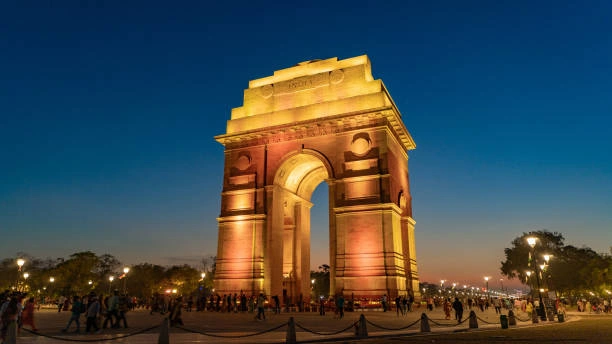
The Lutyens’ Delhi zone that surrounds the President’s Estate is one of the most architecturally coherent planned urban areas in India — and one of the least explored by visitors who arrive for Amrit Udyan and leave without extending the morning into the surrounding heritage.
India Gate (Kartavya Path)
Less than 2 kilometres from Rashtrapati Bhavan at the eastern end of Kartavya Path, India Gate is the 42-metre tall war memorial built in 1931 to commemorate the soldiers of the British Indian Army who died in the First World War. The canopy adjacent to India Gate now houses the Netaji Subhas Chandra Bose statue, installed in 2022 as part of the estate’s transformation. The broad lawns of Kartavya Path between the two ends of the avenue are open to the public and at their most pleasant in the morning hours before midday heat sets in.
National Museum (Janpath)
The National Museum on Janpath, adjacent to Rajpath, holds one of India’s most significant collections of art, archaeology, and decorative arts — spanning 5,000 years from the Indus Valley civilisation through the Mughal period to the present. Specific highlights include the Harappan Gallery (ground floor), the Mughal miniature painting collection, and the Textile Gallery. The museum is open from 10:00 AM to 6:00 PM (closed Mondays). Entry fee applies; camera permits are available.
Combining the Visit
A morning that begins at Gate No. 35 for the 10:00 AM Amrit Udyan opening, spends 1.5 to 2 hours in the gardens, and then moves to India Gate and the National Museum in the afternoon is a coherent and full day in Central Delhi. Add an evening walk through Connaught Place and dinner in the area, and the day covers a significant portion of what Lutyens’ Delhi has to offer in a single well-managed itinerary.
For a comprehensive overview of Delhi’s neighbourhoods, transport, monument timings, and day-trip options from the capital, our Delhi Travel Guide covers the city in practical depth — useful for first-time visitors building a multi-day Delhi itinerary around Amrit Udyan and the Central Delhi heritage zone.
5 Critical Mistakes to Avoid at Amrit Udyan
- The ‘No-Booking’ Trap Arriving at Gate No. 35 without a prior online slot. Walk-in entry is strictly prohibited — no exceptions are made regardless of how far you have travelled. Book your slot on the Official Rashtrapati Bhavan Booking Portal as soon as your date is confirmed.
- The Bag Headache Carrying large backpacks or oversized handbags. Cloakroom queues for bag deposit can take 30 minutes or more during peak weekend mornings in February. Travel light — a small cross-body bag with your phone, ID, and water bottle is the practical approach.
- The Wrong Gate Heading to the main Rashtrapati Bhavan ceremonial gate rather than Gate No. 35 on North Avenue. These are different entry points. GPS apps sometimes direct visitors to the ceremonial approach — confirm Gate No. 35, North Avenue, before departure.
- Monday Visits The gardens are closed every Monday for maintenance. This is the single most common avoidable mistake among first-time visitors who assume public gardens operate seven days a week.
- Professional Camera Gear Carrying DSLR cameras with detachable lenses without checking the latest photography permit requirements. Mobile phone cameras are generally permitted without restriction. For professional equipment, check the current policy on the official booking portal before your visit — requirements can change between seasons.
Essential Security Checklist & Pro-Tips
Entry to the President’s Estate involves security checks consistent with a high-security government installation. Understanding what is and is not permitted before you arrive saves time at the gate and avoids the frustration of having items confiscated or being asked to return to your vehicle.
Restricted and Prohibited Items
The following items are not permitted inside the estate grounds:
- Bags and backpacks — large bags are not permitted. A small handbag or a compact day bag may be acceptable; confirm the size restriction on the booking portal at time of registration
- Food and beverages from outside the estate
- Professional cameras and tripods — DSLR cameras with detachable lenses may be restricted or require a separate photography permit. Smartphone cameras are generally permitted
- Tobacco products — smoking is not permitted within the gardens
- Drones — strictly prohibited; the President’s Estate falls within restricted airspace
Physical ID Requirements
The ID you registered during online booking must be the same ID you present at the gate. Acceptable documents include Aadhaar Card, PAN Card, Passport, Voter ID, and Driving Licence. Digital copies on your phone are generally acceptable, but carrying a physical copy removes any risk of network issues at the gate preventing display.
Practical Tips for a Better Visit
- Arrive 15 minutes before your booked slot — security queues can add time, and early arrival ensures you enter at the beginning of your slot rather than partway through it
- Wear comfortable walking shoes — the Long Garden alone covers 200 metres and the full estate circuit involves significant walking on gravel and grass paths
- The Rectangular Garden and the rose sections photograph best in the morning light (10:00 to 11:30 AM) before the sun moves overhead
- Visit on a weekday if possible — weekend crowds during the February peak are substantial, and the experience of the gardens is noticeably more relaxed on Tuesday through Friday
For personalised travel planning assistance — whether you are building a Delhi itinerary around Amrit Udyan or coordinating a multi-city India trip for a family or corporate group — Contact Suwish Global Travels for a consultation. Our services align with IATA Standards and provide 24/7 Travel Support for international guests. For corporate groups, we handle GST-compliant invoicing for all travel services — flights, accommodation, and ground transport — under a single consolidated account. Our team manages transport coordination, hotel bookings, and complete itinerary planning for Delhi NCR visitors from our Laxmi Nagar office.
Frequently Asked Questions
Is entry to Amrit Udyan free?
Ans Yes. Entry to Amrit Udyan (Mughal Gardens) at Rashtrapati Bhavan is free of charge. However, online advance booking through the Official Rashtrapati Bhavan Booking Portal is mandatory. Walk-in entry is not permitted.
When does Amrit Udyan open for public visits in 2026?
Ans The gardens typically open in late January or early February and close in mid-March. Exact dates for 2026 will be announced by the President’s Secretariat closer to the opening period. The gardens are closed on Mondays.
What are the visiting hours for Amrit Udyan?
Ans The gardens are open from 10:00 AM to 4:00 PM during the public opening period. Last entry is at 4:00 PM; visitors must exit by 5:00 PM.
Can I take my DSLR camera inside?
Ans Professional cameras with detachable lenses may be subject to restrictions or require a separate photography permit. Smartphone cameras are generally permitted. Confirm the current photography policy on the official booking portal before your visit.
How do I reach Amrit Udyan from Connaught Place by Metro?
Ans The nearest Metro station is Central Secretariat on the Yellow Line (Line 2), approximately 1.5 kilometres from Gate No. 35 on South Avenue. The walk from the station to the gate takes approximately 15 to 20 minutes. For families with children or elderly visitors, private transport to the gate is more practical.
What is the best month to visit Amrit Udyan in 2026?
Ans February is the peak month — the roses and seasonal flowers are at their fullest bloom, and the weather in Delhi is pleasant (10°C to 22°C). Early March is also excellent and typically less crowded than the February peak weeks.
Can corporate groups visit Amrit Udyan?
Ans Yes. Group bookings can be made through the official portal. For corporate groups visiting as part of a Delhi itinerary — combining Amrit Udyan with Central Delhi heritage, meetings, or MICE events — pre-arranged group transport from a single pickup point is the most practical coordination approach.