
Amritsar Travel Guide: Delhi to Amritsar and Back — The Complete Route Planner
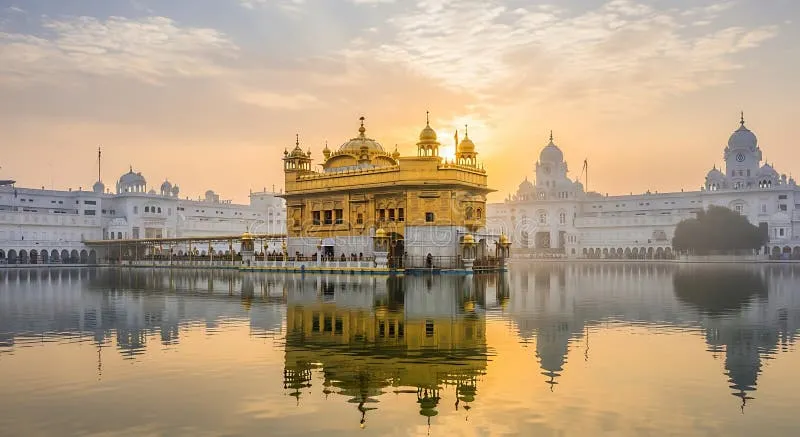
There are cities in India that reward preparation. Amritsar rewards presence. The moment you step into the lane leading to the Golden Temple (officially known as Harmandir Sahib) — at any hour of the day or night — the city makes its impression immediately and completely. But getting there, and getting the most out of the experience, requires more logistical clarity than most travel guides provide.
This Delhi to Amritsar travel guide — put together by the team at Suwish Global Travels — covers the corridor in honest detail — transport options, food, the Wagah Border ceremony, scam awareness, and how Amritsar fits into a wider India itinerary. Whether you are arriving from Delhi at the start of a trip or departing from Amritsar at the end, the logistics here are worth getting right. To plan your trip with verified local support, our team is available for personalised itinerary consultation.
Why Amritsar Works as Both an Entry and Exit Point for India
Most international visitors to North India route themselves through Delhi. That makes sense — Indira Gandhi International Airport handles the majority of long-haul arrivals, and Delhi sits at the centre of the Golden Triangle circuit.
But Sri Guru Ram Dass Jee International Airport in Amritsar has direct connections to several international destinations including Birmingham, Toronto, and Dubai. For visitors of Punjabi heritage travelling from the UK or Canada, Amritsar is often the more natural arrival point. For others, ending a North India trip in Amritsar — and flying out directly — removes the need to backtrack to Delhi and adds one of India’s most singular cities to the final chapter of the journey.
Either way, the Delhi-Amritsar connection is the backbone of this route, and understanding it properly is the starting point for planning.
Flight vs Train vs Road: Choosing Your Delhi-Amritsar Route
Each option on this corridor has a genuine use case. The table below gives an honest comparison for the Delhi to Amritsar travel guide route.
| Mode | Journey Time | Approximate Cost | Best For |
|---|---|---|---|
| Flight | 1 hour 10 min | ₹2,500 – ₹7,000 one way | Time-pressed travellers, business trips |
| Train (Shatabdi) | 5.5 – 6.5 hours | ₹800 – ₹2,200 (AC chair/1AC) | Comfortable mid-budget travel, scenic route |
| Road (NH44) | 7 – 9 hours | ₹6,000 – ₹12,000 (hired car) | Flexible itineraries, stop-en-route trips |
| Route | Distance | Travel Time |
|---|---|---|
| Delhi → Amritsar (Road) | 450 km | 8 – 9 hours |
| Delhi → Amritsar (Flight) | 410 km (air) | 1 hour 10 min |
| Delhi → Amritsar (Train) | 450 km | 5.5 – 6.5 hours |
For travellers prioritising time, a Domestic flight arrangement Delhi to Amritsar is the cleanest option — under 90 minutes door to door once you account for the shorter airport processing at Amritsar compared to Delhi.
For those who want the journey to be part of the experience, the Delhi to Amritsar road trip by car on NH44 via the historic Grand Trunk Road is genuinely worthwhile — particularly if your itinerary includes a stop at Kurukshetra, Karnal, or Ludhiana.
Delhi to Amritsar Route Map: NH44 Corridor
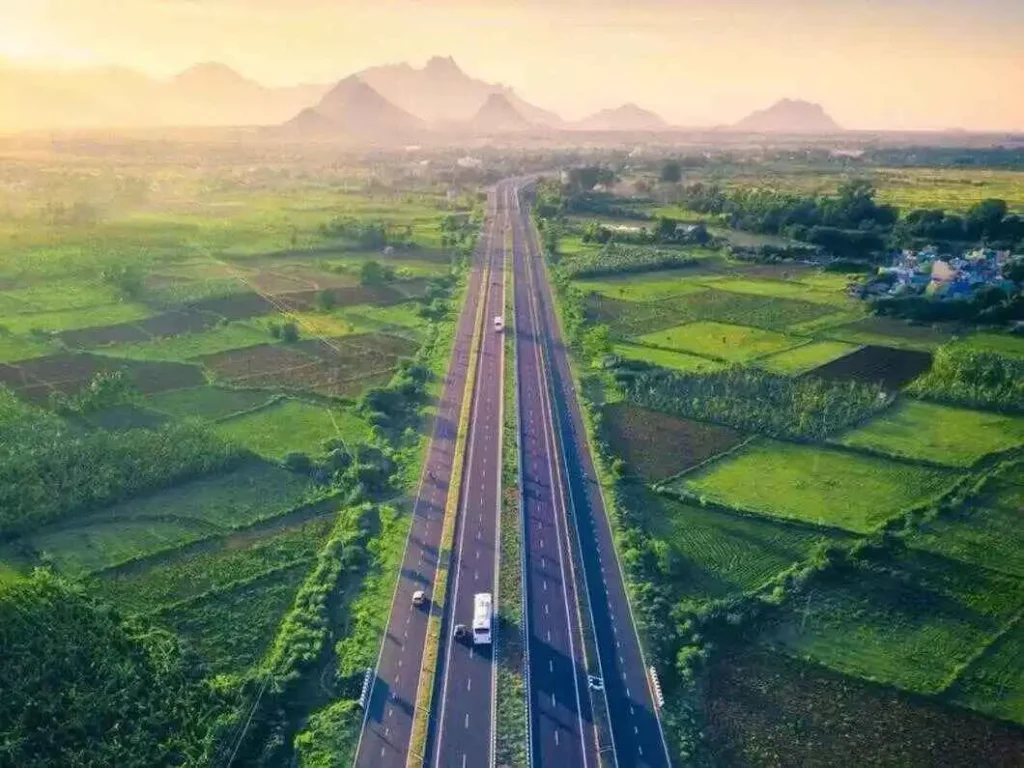
The road route from Delhi to Amritsar follows National Highway 44 — one of India’s longest highways — for the majority of its 450-kilometre length. The sequential towns on this corridor are:
Delhi → Sonipat (45 km) → Panipat (90 km) → Karnal (130 km) → Ambala (200 km) → Ludhiana (310 km) → Jalandhar (375 km) → Amritsar (450 km)
Each of these towns marks a practical waypoint — a fuel stop, a meal break, or a traffic checkpoint to be aware of. Panipat (site of three of India’s most decisive historical battles) and Ambala (a major military cantonment town) are the two points where the highway widens and traffic patterns shift. After Ludhiana, the highway enters Punjab’s heartland and the road quality improves noticeably all the way into Amritsar.
Total driving time without stops: 7 to 8 hours from central Delhi. With two meal stops and a fuel break: 9 to 10 hours. Departing before 6 AM is strongly recommended to clear Delhi’s outer ring road before peak hour.
The G.T. Road Experience: Delhi to Amritsar by Road
The Grand Trunk Road — one of Asia’s oldest and longest roads — runs from Chittagong in Bangladesh through Delhi and up to Peshawar in Pakistan. The Delhi-to-Amritsar stretch of NH44 follows much of this historic corridor and passes through the agricultural heartland of Haryana and Punjab.
In practical terms, the road is well-maintained for most of its length, though the stretch through Ambala and Ludhiana involves urban congestion that can add 45 to 90 minutes to your journey depending on the time of day. Departing Delhi before 6 AM avoids both city traffic and the Ambala bottleneck.
Notable stops on the route worth planning around:
- Karnal (130 km from Delhi) — A genuine dhaba breakfast stop. The roadside dhabas between Karnal and Ambala serve some of the best parathas on the route, made fresh and served with white butter that has no equivalent in a hotel restaurant.
- Ludhiana — Punjab’s industrial capital is not a sightseeing destination, but its food markets are worth a stop if you are travelling in the evening. Tikka and tandoor culture here is distinct from Amritsar’s.
- Phillaur — The Sutlej River crossing just before Jalandhar marks the shift into deeper Punjab. The landscape changes noticeably here — fields wider, sky bigger, the pace of everything slightly slower.
Plan for 8 to 9 hours total including stops, and avoid the road on days following major Punjab public holidays when return traffic from Amritsar to Delhi is heavy.
The Golden Temple (Harmandir Sahib): Practical Logistics
The Golden Temple is open to visitors of all faiths, around the clock, every day of the year — no entry fees, no booking required. That is the logistics summary. The spiritual reality of Harmandir Sahib — built in the 16th century and rebuilt in its current gold-plated form in the early 19th century — is something the logistics cannot capture.
The most photographed moment — the Golden Temple reflecting on the sarovar (sacred pool) at dawn — happens between 4:30 and 6:00 AM. This requires either staying within walking distance or arranging early transport. Most hotels within the old city are within 15 minutes on foot.
Practical requirements before entry: head must be covered (scarves available at the entrance), shoes must be removed and stored (free), feet must be washed at the entrance channel. Photography is permitted throughout the complex.
The langar (community kitchen) at Harmandir Sahib operates continuously and serves a free meal to anyone who sits — according to the Shiromani Gurdwara Parbandhak Committee (SGPC), the langar serves over 100,000 meals daily, making it one of the largest free community kitchens in the world. The experience of eating alongside several hundred people in the langar hall is as significant as the Golden Temple itself.
For accommodation close to the temple complex, Top-rated hotels booking in Amritsar ranging from heritage properties in the old city to business hotels near the airport can be arranged based on your itinerary and budget.
Jallianwala Bagh: The Historical Site Every Visitor Should Understand
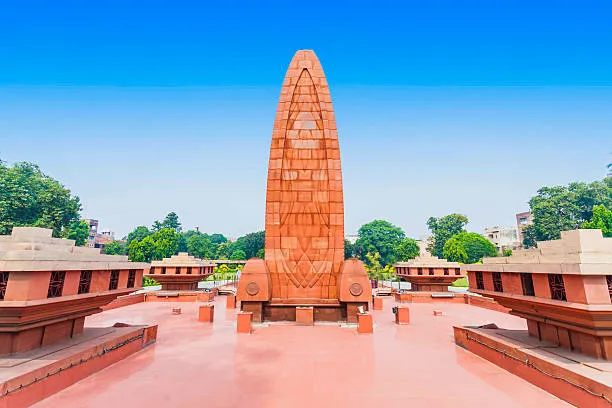
Jallianwala Bagh is a 6-acre public garden located approximately 200 metres from the Golden Temple — a 5-minute walk through the lanes of the old city. Most visitors combine both in the same morning.
On 13 April 1919, British Indian Army troops under the command of Brigadier General Reginald Dyer opened fire on a large gathering of unarmed civilians — men, women, and children who had assembled for the Baisakhi festival. The narrow exits were blocked before the firing began. Hundreds were killed; the official British inquiry recorded 379 deaths, while Indian National Congress estimates placed the figure significantly higher. The event became one of the pivotal moments in India’s independence movement.
What you will find at the site today:
- The garden and memorial — The bullet marks on the surrounding walls have been preserved. The well into which many people jumped to escape the firing is still visible, now surrounded by a memorial enclosure
- The Eternal Flame (Amar Jyoti) — A flame that has been burning continuously since 1961 in memory of those killed
- The museum — A detailed account of the massacre, the surrounding political context, and the events that followed. Allow 30 to 45 minutes for the museum if you want to understand the full significance of what happened here
- Time needed: 45 minutes to 1 hour for the garden and memorial; 90 minutes if including the museum
Entry is free. The site is managed by the Jallianwala Bagh National Memorial Trust. It is open from 6:30 AM to 7:30 PM (summer) and 7:00 AM to 6:00 PM (winter).
Visiting Jallianwala Bagh without understanding its context reduces it to a garden with old walls. It deserves more than that — and the museum, which is brief but well-curated, provides the context in under an hour.
Beyond the Gold: The Architectural Mirror of Durgiana Temple (Silver Temple)
Two kilometres from Harmandir Sahib sits a temple that most visitors to Amritsar never reach — the Durgiana Temple, commonly known as the Silver Temple. Built in the 16th century and dedicated to the goddess Durga, it is architecturally modelled on the Golden Temple: the same sarovar (sacred pool), the same causeway leading to the sanctum, the same concept of a temple rising from water.
Where Harmandir Sahib is covered in gold, Durgiana Temple’s doors and panels are worked in embossed silver — intricate craftsmanship that rewards close attention. The complex is significantly quieter than the Golden Temple, which makes it easier to appreciate the architecture and the atmosphere without the press of crowds.
For travellers interested in the religious and architectural history of Punjab beyond the Sikh tradition, Durgiana Temple completes the picture that the Golden Temple begins. It adds no more than 90 minutes to a morning itinerary and is reachable by auto-rickshaw or a short walk from the Amritsar railway station area.
The Wagah Border Beat Retreat Ceremony
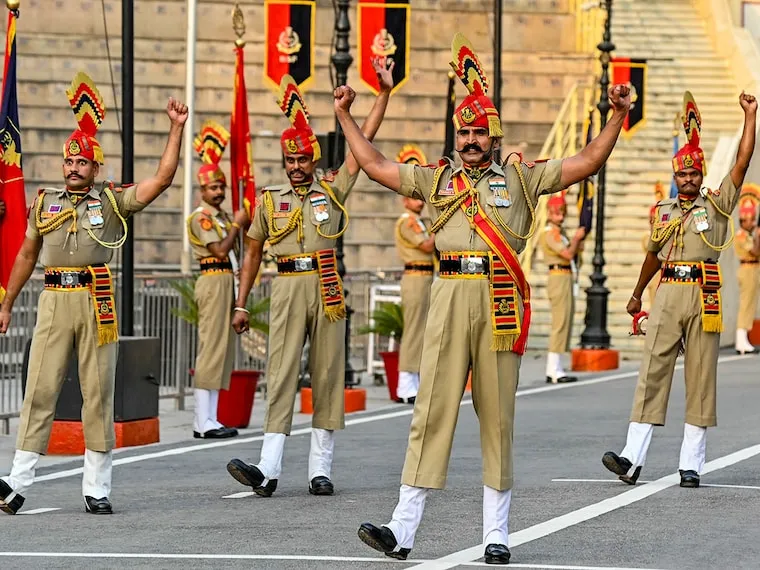
The Wagah Border — 28 kilometres from Amritsar city centre — hosts the daily flag-lowering ceremony between Indian and Pakistani border security forces. The daily Beat Retreat ceremony, conducted with clockwork precision by the Border Security Force (BSF) on the Indian side and the Pakistan Rangers across the line, is a masterclass in military coordination — and one of the most watched border rituals in the world. The energy in the stands on the Indian side is unlike almost anything else on a North India itinerary.
Best Time to Visit Wagah Border
The ceremony takes place at sunset, which means the timing shifts throughout the year:
- October to February (Winter): Ceremony begins approximately 4:00 – 4:30 PM
- March to May (Spring/Pre-Summer): Ceremony begins approximately 5:15 – 5:45 PM
- June to September (Summer/Monsoon): Ceremony begins approximately 6:15 – 6:45 PM
Arrive at least 60 to 90 minutes before the ceremony — the stands fill up well before the gates close, particularly on weekends and public holidays.
Seating Zones
The seating area is divided into two sections: a general gallery (free, fills fastest) and a closer viewing enclosure. There is no official “VIP pass” required or sold for Wagah Border — this is a common misconception exploited by touts who approach tourists near the city centre. Entry is free for all Indian and foreign nationals with valid identification. Do not pay anyone for entry tickets or “special access.”
Pro-tip on transport: Do not rely on unmetered auto-rickshaws or shared cabs from the city centre for the Wagah trip. The return journey after the ceremony involves several thousand people leaving the border area simultaneously — drivers know this and prices surge significantly. Pre-arrange a return vehicle with a fixed rate before you leave the hotel. Suwish Global Travels coordinates Wagah return trips with fixed pricing and a verified local transport service — driver waits through the ceremony, rate confirmed before departure.
The road between Amritsar and Wagah passes through the town of Attari and several villages. The GT Road stretch here is lined with flags and roadside stalls — the atmosphere builds well before you reach the border gates.
The Ambarsari Food Trail
Amritsar’s food identity is inseparable from its cultural identity. The city gave India the kulcha, and the version made here — in wood-fired tandoors, stuffed with spiced potato or paneer, served with chole and raw onion — has no genuine equivalent anywhere else in the country.
A practical food trail covering the essential stops:
- Kesar Da Dhaba, Shastri Market (est. 1916) — Over a century of operation without shortcuts. Dal makhani and paneer dishes cooked in the original style — slow, in iron vessels, without the flavour-enhancing additions that most modern restaurants rely on. A legendary stop recommended by food writers and B2B travel operators alike. Arrive before 1 PM for lunch or before 8 PM for dinner — no reservations taken
- Kulcha Land / Brother Dhaba, Lawrence Road — The benchmark for authenticity in Amritsari kulcha. Wood-fired tandoor, spiced potato or paneer filling, white butter applied immediately on removal from the heat, served with chole and raw onion. Nothing else is required or recommended
- Bharawan Da Dhaba, Town Hall (Town Hall Legacy Since 1912) — The older of the two famous dhabas in the Town Hall area, operating from the same location for over a century. Reliable across the full menu; the lassi is made in the traditional style — thick, slightly sour, served in a clay glass that keeps it cold
- Gurdas Ram Jalebi, Katra Ahluwalia — Jalebis made fresh in the original wide, irregular style from a recipe that has not changed in over a century. Best eaten hot, immediately
- Fish and Chicken near Putlighar — Amritsar’s non-vegetarian tradition is equally serious. The fish tikka and chicken dishes here are marinated and cooked differently from Delhi-style preparations — less sweet, more smoke
One honest note: the food in Amritsar is rich and heavy. Pacing across two to three meals rather than trying everything in one sitting is both more practical and more enjoyable.
The Amritsar Anti-Scam Playbook
Amritsar is a genuinely hospitable city. The incidents described below are not representative of local culture — they are specific patterns that target tourists near the Golden Temple and at the railway station.
Scam 1: The “Free Temple Tour Guide” Approach
Modus Operandi: A well-dressed man approaches near the temple entrance, offers to explain the history and significance of the complex, and accompanies you through the visit. At the end, he requests payment — often significantly above what was discussed or implied — and may become persistent.
Solution: The Golden Temple has official information boards throughout the complex in multiple languages. Official guides can be arranged through the Shiromani Gurdwara Parbandhak Committee (SGPC) at a fixed rate. Decline unsolicited accompaniment politely and firmly from the outset.
Scam 2: The “Your Hotel is Closed / Overbooked” Taxi Redirect
Modus Operandi: A taxi or auto driver picking you up from the railway station or airport tells you your booked hotel has “closed” or “had a fire” and offers to take you to an alternative where he receives commission.
Solution: Call your hotel directly before getting into the vehicle. Confirm your booking. Do not accept redirection. Travellers who pre-book airport and station pickups through Suwish Global Travels receive a named driver with photo ID and vehicle registration before arrival — eliminating this vulnerability entirely.
Scam 3: The Prasad Seller Overcharge
Modus Operandi: Vendors near the temple entrance sell prasad (offerings) and quote prices that are significantly above standard. When challenged, they may claim that the prasad is “special” or “required” for entry.
Solution: Prasad is not required for entry to the Golden Temple. If you wish to make an offering, purchase from vendors inside the SGPC-managed complex rather than from street vendors outside.
2-Day Amritsar Itinerary from Delhi
This Delhi to Amritsar travel guide itinerary assumes arrival by overnight train or early morning flight from Delhi.
This schedule is full but not rushed. The only constraint is Wagah — the timing is fixed by the ceremony, and everything else should be arranged around it.
5 Mistakes Travellers Make in Amritsar
- Arriving late at Wagah Border The stands close well before the ceremony begins. Arriving 30 minutes before the scheduled time — as many visitors do — means standing at the back or missing entry entirely. Build 90 minutes of buffer into your Wagah afternoon.
- Eating everything in one sitting The Ambarsari food trail covers kulcha, lassi, dal makhani, jalebis, and fish — all within a few hundred metres of each other. Attempting all of it in one meal is a reliable way to spend the following morning indoors. Spread the food trail across Day 1 lunch, Day 1 dinner, and Day 2 breakfast.
- Visiting the Golden Temple only during the day The temple at 10 AM — when tour groups arrive in volume — is a different experience from the temple at 5 AM or 11 PM. If your schedule allows, visit twice: once during daylight and once after midnight. Both are worth the effort.
- Treating Jallianwala Bagh as a brief stop Most visitors spend 15 minutes here and move on. The site rewards more time and more preparation. Reading the basic history of the 1919 massacre before your visit changes what you see when you are there.
- Using random taxis for the Wagah return Covered in detail in the anti-scam section above — but worth repeating as a standalone mistake. The post-ceremony taxi situation at Wagah is chaotic and price-inflated. Pre-arranged fixed-rate transport is the only sensible option.
Returning to Delhi: Planning the Outbound Journey
If Amritsar is the final stop on your North India circuit, the return to Delhi requires the same transport decisions as the inward journey — with one additional consideration: Amritsar railway station handles significant volumes of outbound traffic, and train tickets on the Shatabdi and other express services should be booked at least two to three weeks in advance during peak season (October to March and summer school holidays).
For travellers continuing beyond Delhi to Agra or Jaipur on the Golden Triangle circuit, the logistics of that connection are covered in full in our Delhi Travel Guide — including transport options, timing, and what to prioritise in each city. Suwish Global Travels manages end-to-end North India itineraries from its base in Laxmi Nagar, Delhi, covering the full Amritsar-Delhi-Agra-Jaipur circuit as a single coordinated programme.
Frequently Asked Questions
How far is Amritsar from Delhi?
Ans By road, Amritsar is approximately 450 kilometres from Delhi via NH44. By air, the flight time is around 1 hour 10 minutes. By Shatabdi Express, the journey takes approximately 6 hours.
What is the best time to visit Amritsar?
Ans October to March is the most comfortable period — temperatures are manageable and the harvest festivals of Lohri (January) and Baisakhi (April) fall within or just outside this window. April and May are hot but manageable. The monsoon months of July and August bring humidity and occasional flooding on the GT Road.
Is Amritsar safe for solo female travellers?
Ans Yes. The Golden Temple complex and the surrounding old city are among the most visited and well-managed public spaces in North India. The Sikh cultural emphasis on hospitality and community makes Amritsar a particularly welcoming destination. Standard urban precautions apply at night near the railway station.
What should I wear at the Golden Temple?
Ans Head covering is mandatory — scarves are available free at the entrance. Modest clothing covering shoulders and knees is appropriate. Shoes must be removed before entering. There is no dress code beyond these requirements.
Can I visit Wagah Border from Amritsar on a day trip?
Ans Yes. Wagah is 28 kilometres from the city centre and easily managed as a late afternoon trip. Allow 90 minutes for the drive depending on traffic, arrive at least 60 to 90 minutes before the ceremony, and pre-arrange return transport before you leave.
Is the Golden Temple open at night?
Ans Yes. Harmandir Sahib is open 24 hours, every day of the year. The hours between 2 AM and 5 AM are among the quietest and most contemplative times to visit — the crowds are minimal and the atmosphere is distinct from daytime visits.
How many days are enough for Amritsar?
Ans Two full days covers the Golden Temple, Jallianwala Bagh, Wagah Border, and the food trail without rushing. Three days allows for a more relaxed pace and the option of a half-day trip to the Punjabi countryside or Anandpur Sahib.
What is the best way to get from Amritsar Airport to the city?
Ans Sri Guru Ram Dass Jee International Airport is approximately 11 kilometres from the city centre. Prepaid taxis from the airport are available at a fixed rate and the journey takes 20 to 30 minutes depending on traffic. For those using this Delhi to Amritsar travel guide as part of a return trip, direct flights back to Delhi depart from this airport — pre-arranged pickup from the city saves both time and the uncertainty of negotiating rates on the day.
Is Amritsar a good addition to the Golden Triangle route?
Ans It is one of the best extensions to the standard Delhi-Agra-Jaipur circuit. Amritsar adds a completely different register — spiritual, culinary, and historically significant in ways that complement rather than duplicate the monuments of the Golden Triangle. Suwish Global Travels covers how to integrate Amritsar into a wider North India trip through its Golden Triangle India itinerary planning service — contact our travel experts for a customised routing based on your arrival city and travel dates.
What language is spoken in Amritsar?
Ans Punjabi is the primary language. Hindi is widely understood and spoken. English is available at hotels, restaurants in tourist areas, and at the Golden Temple information centre. Outside tourist zones, basic Hindi is more useful than English for day-to-day navigation.